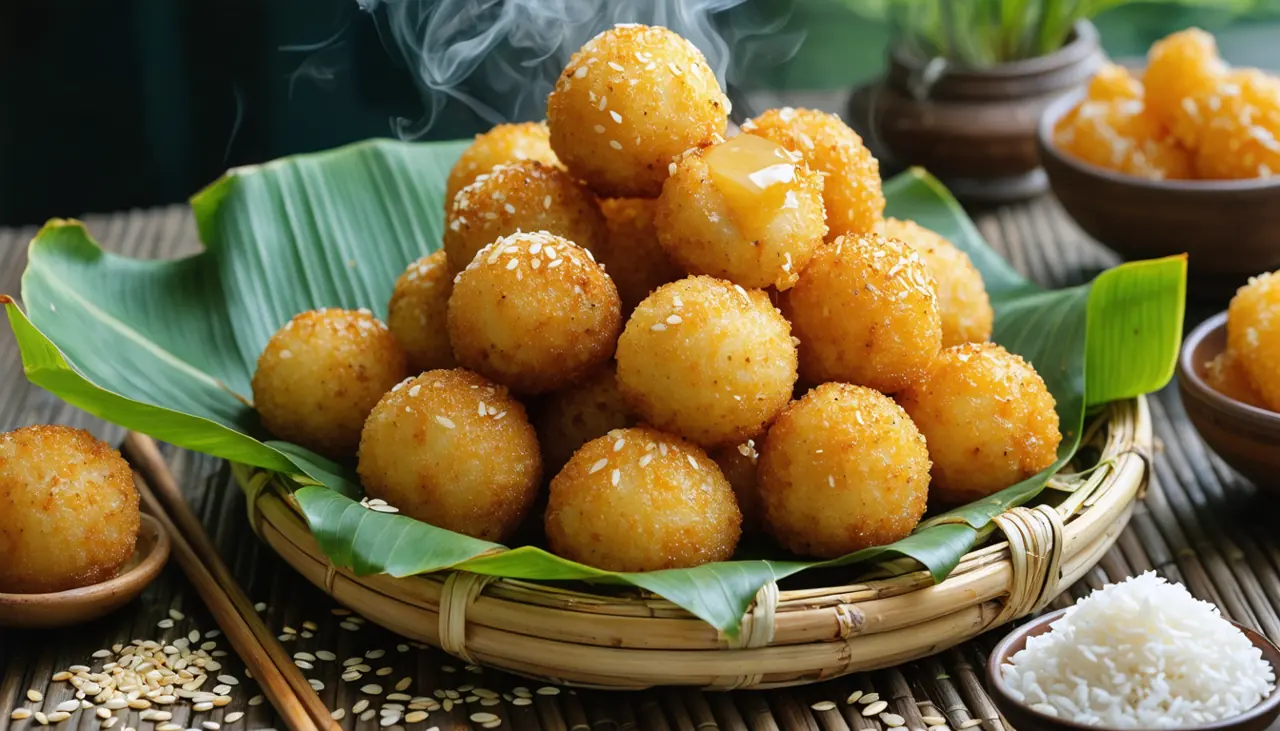
Onde-onde (boules de sésame au haricot mungo)
Boules moelleuses de riz gluant à la croûte de sésame croustillante, fourrées d'une pâte sucrée de haricot mungo.
Portions
Ingrédients
Nutrition
Par portion
Étapes

Cook the mung beans
Drain the soaked mung beans and put them in a pot with fresh water to cover by about 5 cm. Simmer until completely soft and falling apart, 20–25 minutes, then drain well.
- 150 g soaked mung beans
✅ C'est prêt quand : a bean mashes to a smooth paste with no bite left when pressed between your fingers

Make the filling
Mash the hot beans with a fork or blend briefly, then return to the pot with the sugar, pandan leaf, salt and coconut milk. Cook over low heat, stirring often, until the mixture is dry enough to hold its shape and no longer sticks wetly to the spoon. Let it cool, discard the pandan leaf, then roll into 20 small balls about the size of a cherry.
- 100 g sugar
- 1 pandan leaf
- 1/4 tsp salt
- 50 ml coconut milk
✅ C'est prêt quand : the paste pulls away cleanly from the pan and holds a shape when rolled
Make the dough
This step is part of Foodie Premium. Subscribe to unlock the full method, cooking mode and every recipe in the library.
Fill and shape
This step is part of Foodie Premium. Subscribe to unlock the full method, cooking mode and every recipe in the library.
Coat in sesame
This step is part of Foodie Premium. Subscribe to unlock the full method, cooking mode and every recipe in the library.
Fry low, then hot
This step is part of Foodie Premium. Subscribe to unlock the full method, cooking mode and every recipe in the library.
Drain and serve
This step is part of Foodie Premium. Subscribe to unlock the full method, cooking mode and every recipe in the library.
Cook the mung beans
Drain the soaked mung beans and put them in a pot with fresh water to cover by about 5 cm. Simmer until completely soft and falling apart, 20–25 minutes, then drain well.
- 150 g soaked mung beans
✅ C'est prêt quand : a bean mashes to a smooth paste with no bite left when pressed between your fingers
Make the filling
Mash the hot beans with a fork or blend briefly, then return to the pot with the sugar, pandan leaf, salt and coconut milk. Cook over low heat, stirring often, until the mixture is dry enough to hold its shape and no longer sticks wetly to the spoon. Let it cool, discard the pandan leaf, then roll into 20 small balls about the size of a cherry.
- 100 g sugar
- 1 pandan leaf
- 1/4 tsp salt
- 50 ml coconut milk
✅ C'est prêt quand : the paste pulls away cleanly from the pan and holds a shape when rolled
Make the dough
This step is part of Foodie Premium. Subscribe to unlock the full method, cooking mode and every recipe in the library.
Fill and shape
This step is part of Foodie Premium. Subscribe to unlock the full method, cooking mode and every recipe in the library.
Coat in sesame
This step is part of Foodie Premium. Subscribe to unlock the full method, cooking mode and every recipe in the library.
Fry low, then hot
This step is part of Foodie Premium. Subscribe to unlock the full method, cooking mode and every recipe in the library.
Drain and serve
This step is part of Foodie Premium. Subscribe to unlock the full method, cooking mode and every recipe in the library.
The Story Behind the Dish
Onde-onde is a classic Indonesian sweet snack with deep roots in Javanese home cooking and market stalls. The sesame-coated shell and tender mung bean filling reflect ingredients that have long been staples across the Indonesian archipelago, where rice, sesame and legumes feature widely in everyday cooking and festive treats alike.
Over time the snack spread well beyond Java, becoming a familiar sight at traditional markets, roadside carts and family gatherings throughout Indonesia. Its appeal lies in the simple contrast it offers: a crisp, nutty crust giving way to a soft, chewy interior and a mellow sweet filling, a combination that has kept it popular across generations.
⭐ Why It's Famous
Onde-onde is loved for its playful texture contrast and its status as an affordable, satisfying snack found at markets and street stalls across Indonesia.
💡 Fun Fact
The same name, onde-onde, is also used in parts of Southeast Asia for a different snack, so travellers sometimes find the term describes more than one treat depending on the region.
Indonesia, particularly Java
-7.80°S, 110.37°E
Recettes similaires
Comments (0)
No comments yet. Be the first to share your thoughts!