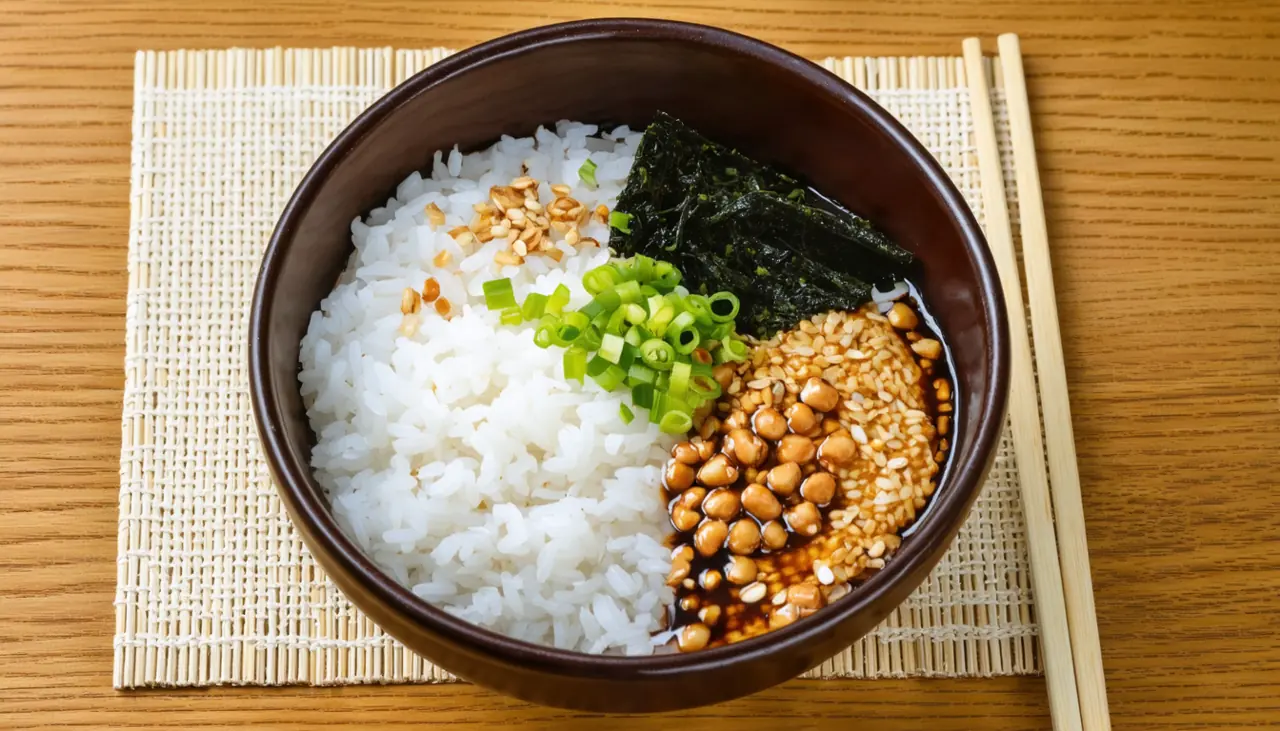
Soja fermenté sur riz (Natto Gohan)
Soja fermenté, collant et puissant, assaisonné de sauce soja et de moutarde forte, servi sur du riz chaud.
Portions
Ingrédients
Nutrition
Par portion
Étapes

Rinse the rice
Put the rice in a bowl, cover with cold water, and swirl it with your hand; drain and repeat two or three times until the water looks mostly clear. This washes off excess surface starch so the rice cooks up fluffy instead of gummy.
- 150 g rice
✅ C'est prêt quand : the rinse water looks mostly clear, not cloudy

Cook the rice
Put the rinsed rice and the water in a small heavy pot with a lid. Bring to a boil, then cover and cook on low heat (around 95°C/203°F simmer) for 12 minutes without lifting the lid; turn off the heat and let it rest, covered, for 10 minutes so the grains finish steaming evenly.
- 150 g rice (from step 1)
- 200 ml water
✅ C'est prêt quand : the rice is tender, glossy, and holds together when pressed with a spoon

Stir the natto until sticky
Open the natto packs and stir the beans briskly with chopsticks or a fork for about 30 seconds, before adding anything else. This whips air into the sticky strings, called nebari, and makes the natto creamier and milder tasting.
- 2 packs (90 g) natto
✅ C'est prêt quand : the beans are coated in thick, webby strings that stretch when lifted

Season with soy sauce and mustard
Add the soy sauce and the karashi mustard (use the small packets that come with the natto if your package has them). Stir again until the sauce is fully worked into the sticky strings.
- 2 tsp soy sauce
- 1/2 tsp karashi mustard
✅ C'est prêt quand : the natto looks glossy and no liquid pools at the bottom of the bowl

Add the scallions
Fold in the sliced scallions and the sesame seeds, mixing just enough to spread them through the natto.
- 2 scallions
- 1 tsp sesame seeds
✅ C'est prêt quand : the scallions are evenly distributed through the sticky beans

Serve over hot rice
Spoon the hot rice into bowls and top with the seasoned natto. Scatter the nori strips over the top if using, and eat right away while the rice is hot and the natto still tastes its freshest.
- 150 g cooked rice (from step 2)
- 1 sheet nori strips (optional)
Rinse the rice
Put the rice in a bowl, cover with cold water, and swirl it with your hand; drain and repeat two or three times until the water looks mostly clear. This washes off excess surface starch so the rice cooks up fluffy instead of gummy.
- 150 g rice
✅ C'est prêt quand : the rinse water looks mostly clear, not cloudy
Cook the rice
Put the rinsed rice and the water in a small heavy pot with a lid. Bring to a boil, then cover and cook on low heat (around 95°C/203°F simmer) for 12 minutes without lifting the lid; turn off the heat and let it rest, covered, for 10 minutes so the grains finish steaming evenly.
- 150 g rice (from step 1)
- 200 ml water
✅ C'est prêt quand : the rice is tender, glossy, and holds together when pressed with a spoon
Stir the natto until sticky
Open the natto packs and stir the beans briskly with chopsticks or a fork for about 30 seconds, before adding anything else. This whips air into the sticky strings, called nebari, and makes the natto creamier and milder tasting.
- 2 packs (90 g) natto
✅ C'est prêt quand : the beans are coated in thick, webby strings that stretch when lifted
Season with soy sauce and mustard
Add the soy sauce and the karashi mustard (use the small packets that come with the natto if your package has them). Stir again until the sauce is fully worked into the sticky strings.
- 2 tsp soy sauce
- 1/2 tsp karashi mustard
✅ C'est prêt quand : the natto looks glossy and no liquid pools at the bottom of the bowl
Add the scallions
Fold in the sliced scallions and the sesame seeds, mixing just enough to spread them through the natto.
- 2 scallions
- 1 tsp sesame seeds
✅ C'est prêt quand : the scallions are evenly distributed through the sticky beans
Serve over hot rice
Spoon the hot rice into bowls and top with the seasoned natto. Scatter the nori strips over the top if using, and eat right away while the rice is hot and the natto still tastes its freshest.
- 150 g cooked rice (from step 2)
- 1 sheet nori strips (optional)
The Story Behind the Dish
Natto is thought to have appeared when boiled soybeans, stored or carried wrapped in rice straw, fermented from the natural bacteria living on the straw, turning sticky and strongly aromatic. Mito, in Ibaraki Prefecture, is closely linked to this history and remains one of Japan's most famous natto-producing towns.
By the Edo period, natto sellers walked the streets of old Tokyo calling out to sell fresh natto each morning, and the dish settled into its familiar role: a few spoonfuls stirred with soy sauce and a little hot mustard, served over hot rice to start the day.
⭐ Why It's Famous
Its sticky texture and strong smell make natto one of Japan's most divisive foods, but at home it is loved for its deep umami, its nutrition, and the simple comfort of a hot bowl of rice each morning.
💡 Fun Fact
Natto is eaten far more often in eastern Japan, especially around Tokyo and Ibaraki, than in western regions like Osaka and Kyoto, where many people grew up rarely eating it at all.
Mito, Ibaraki Prefecture
36.34°N, 140.45°E
Recettes similaires


Comments (0)
No comments yet. Be the first to share your thoughts!