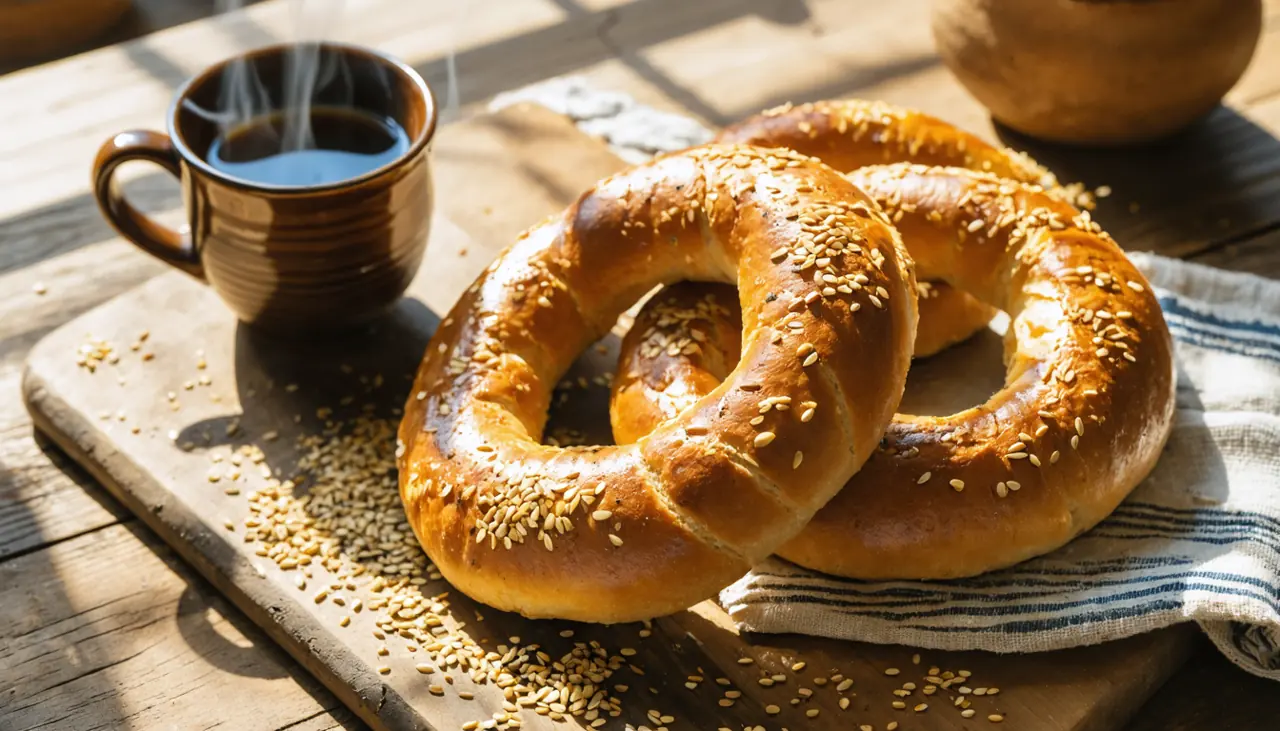
Couronne au sésame de Thessalonique
Anneaux de pain moelleux trempés dans l'eau de mélasse de raisin et enrobés de graines de sésame, vendus dans la rue à Thessalonique.
Portions
Ingrédients
Nutrition
Par portion
Étapes

Make the dough
Stir the yeast and sugar into the warm water and let it sit for 5 minutes until foamy; this tells you the yeast is alive. Add the flour, salt and olive oil, then knead for 8–10 minutes until smooth and elastic. Good kneading develops the gluten that gives these rings their chewy bite.
- 7 g instant yeast
- 50 g sugar
- 300 ml warm water
- 500 g bread flour
- 10 g salt
- 60 ml olive oil
✅ C'est prêt quand : the dough is smooth, slightly tacky, and springs back when you poke it

First rise
Shape the dough into a ball, place it in a lightly oiled bowl, cover with a damp towel or plastic wrap, and leave somewhere warm to rise.
✅ C'est prêt quand : the dough has doubled in size and holds a dent when gently poked

Shape the rings
Divide the dough into 8 equal pieces. Roll each piece into a rope about 35 cm long, fold it in half and twist the two strands together like a rope, then join the ends firmly to form a ring. Pressing the seam well stops the ring from coming apart as it bakes.
✅ C'est prêt quand : you have 8 twisted rings with the ends pinched securely together

Coat in sesame
Soak the sesame seeds in water for a few minutes, then drain; this helps them stick evenly and toast without scorching. Dip each ring briefly in the water mixed with grape molasses, then roll it in the drained sesame seeds, pressing gently so they cover the whole surface.
- 200 g sesame seeds
- 150 ml water (for soaking)
- 150 ml water (for dipping)
- 2 tbsp grape molasses
✅ C'est prêt quand : each ring is completely covered in sesame with no bare patches of dough

Second rise
Place the coated rings on a baking tray lined with parchment paper, spaced well apart, and cover loosely with a towel. Let them rise again until puffy; this short second rise keeps the ring shape instead of letting it spread flat.
✅ C'est prêt quand : the rings look noticeably puffier and the sesame coating feels set

Bake
Preheat the oven to 200°C (400°F) and bake the rings for 20–22 minutes until deeply golden all over, including underneath. The high heat gives a crisp sesame crust while keeping the inside soft and chewy.
✅ C'est prêt quand : deep golden brown, the crust feels firm, and the bottom sounds hollow when tapped
Make the dough
Stir the yeast and sugar into the warm water and let it sit for 5 minutes until foamy; this tells you the yeast is alive. Add the flour, salt and olive oil, then knead for 8–10 minutes until smooth and elastic. Good kneading develops the gluten that gives these rings their chewy bite.
- 7 g instant yeast
- 50 g sugar
- 300 ml warm water
- 500 g bread flour
- 10 g salt
- 60 ml olive oil
✅ C'est prêt quand : the dough is smooth, slightly tacky, and springs back when you poke it
First rise
Shape the dough into a ball, place it in a lightly oiled bowl, cover with a damp towel or plastic wrap, and leave somewhere warm to rise.
✅ C'est prêt quand : the dough has doubled in size and holds a dent when gently poked
Shape the rings
Divide the dough into 8 equal pieces. Roll each piece into a rope about 35 cm long, fold it in half and twist the two strands together like a rope, then join the ends firmly to form a ring. Pressing the seam well stops the ring from coming apart as it bakes.
✅ C'est prêt quand : you have 8 twisted rings with the ends pinched securely together
Coat in sesame
Soak the sesame seeds in water for a few minutes, then drain; this helps them stick evenly and toast without scorching. Dip each ring briefly in the water mixed with grape molasses, then roll it in the drained sesame seeds, pressing gently so they cover the whole surface.
- 200 g sesame seeds
- 150 ml water (for soaking)
- 150 ml water (for dipping)
- 2 tbsp grape molasses
✅ C'est prêt quand : each ring is completely covered in sesame with no bare patches of dough
Second rise
Place the coated rings on a baking tray lined with parchment paper, spaced well apart, and cover loosely with a towel. Let them rise again until puffy; this short second rise keeps the ring shape instead of letting it spread flat.
✅ C'est prêt quand : the rings look noticeably puffier and the sesame coating feels set
Bake
Preheat the oven to 200°C (400°F) and bake the rings for 20–22 minutes until deeply golden all over, including underneath. The high heat gives a crisp sesame crust while keeping the inside soft and chewy.
✅ C'est prêt quand : deep golden brown, the crust feels firm, and the bottom sounds hollow when tapped
The Story Behind the Dish
Sesame-coated bread rings have been baked around the eastern Mediterranean for centuries, and koulouri shares its roots with other sesame breads of the region, such as Turkish simit. In Thessaloniki, a city shaped by centuries of Ottoman rule and a mix of Greek, Jewish and Balkan communities, this bread became a distinct local specialty, sold from wooden carts and trays balanced on vendors' heads or shoulders.
Over time it spread to other Greek cities, but Thessaloniki remains its true home, where koulourtzides (koulouri sellers) still set up early in the morning near schools, offices and university gates.
⭐ Why It's Famous
It is loved for the contrast between the crisp, nutty sesame crust and the soft, chewy bread inside, and for being the easiest, most portable breakfast a Greek city has to offer.
💡 Fun Fact
Koulouri sellers are such a fixture outside Thessaloniki's university campuses that the bread has become shorthand for a quick, cheap student breakfast grabbed on the way to class.
Thessaloniki, Greece
40.64°N, 22.94°E
Recettes similaires
Comments (0)
No comments yet. Be the first to share your thoughts!