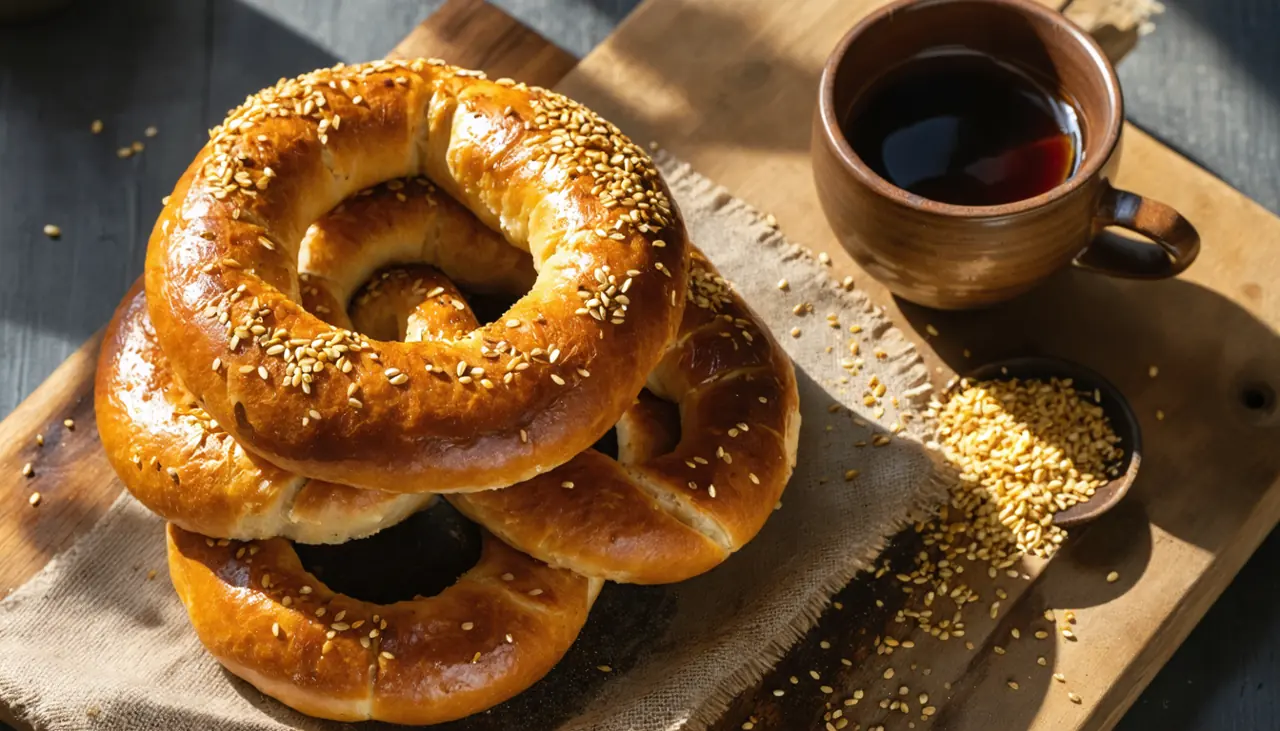
Kaak (anneaux de pain au sésame)
Anneaux de pain croustillants enrobés de sésame, farcis de za'atar ou de fromage, comme dans la rue à Beyrouth.
Portions
Ingrédients
Nutrition
Par portion
Étapes

Mix the dough
In a large bowl, whisk the flour, yeast, sugar, salt, anise and mahlab. Add the olive oil, warm milk and enough warm water to bring it together, then knead by hand or in a mixer for 8–10 minutes.
- 500 g flour
- 7 g yeast
- 10 g sugar
- 8 g salt
- 1 tsp ground anise
- ½ tsp mahlab
- 60 ml olive oil
- 250 ml warm milk
- 60–80 ml warm water
✅ C'est prêt quand : the dough is smooth, elastic and pulls away cleanly from your hands

First rise
Shape the dough into a ball, put it in a lightly oiled bowl, cover with a damp cloth and leave in a warm spot until it doubles in size. This slow rise is what gives kaak its light, chewy inside.
✅ C'est prêt quand : the dough has doubled and holds the dent of a poked finger

Shape the rings
Punch down the dough and divide it into 8 equal pieces. Roll each piece into a rope about 30 cm long, bring the ends together to form a ring and press firmly to seal, pinching a little tail on one side if you want the classic handbag shape.
✅ C'est prêt quand : you have 8 neat, well-sealed rings that hold their shape on the counter

Coat in sesame
Stir the grape molasses with the water in a shallow bowl. Dip each ring in the molasses wash to cover it completely, then press it into the sesame seeds, turning so every side is thickly coated.
- 3 tbsp grape molasses
- 3 tbsp water
- 120 g sesame seeds
✅ C'est prêt quand : each ring is sticky and evenly covered in sesame seeds with no bare patches

Second rise
Lay the coated rings on a baking tray lined with parchment, leaving space between them, and let them rest uncovered for 20 minutes while you preheat the oven. This short rest lets the crust set so the rings keep their shape in the oven.
✅ C'est prêt quand : the rings look slightly puffed and the surface feels a little dry to the touch

Bake until golden
Bake at 200°C (400°F) for 18–20 minutes, until the kaak are a deep golden brown and sound hollow when tapped on the base. Rotate the tray halfway through for even colour.
✅ C'est prêt quand : the rings are deep golden, firm, and crisp on the outside

Fill and serve
While the kaak are still warm, split each ring open like a pocket without cutting all the way through. Mix the za'atar with the olive oil and spoon it inside, or tuck in shredded cheese and warm briefly until it softens. Serve right away.
- 60 g za'atar
- 60 ml olive oil
- 200 g cheese (optional alternative)
Mix the dough
In a large bowl, whisk the flour, yeast, sugar, salt, anise and mahlab. Add the olive oil, warm milk and enough warm water to bring it together, then knead by hand or in a mixer for 8–10 minutes.
- 500 g flour
- 7 g yeast
- 10 g sugar
- 8 g salt
- 1 tsp ground anise
- ½ tsp mahlab
- 60 ml olive oil
- 250 ml warm milk
- 60–80 ml warm water
✅ C'est prêt quand : the dough is smooth, elastic and pulls away cleanly from your hands
First rise
Shape the dough into a ball, put it in a lightly oiled bowl, cover with a damp cloth and leave in a warm spot until it doubles in size. This slow rise is what gives kaak its light, chewy inside.
✅ C'est prêt quand : the dough has doubled and holds the dent of a poked finger
Shape the rings
Punch down the dough and divide it into 8 equal pieces. Roll each piece into a rope about 30 cm long, bring the ends together to form a ring and press firmly to seal, pinching a little tail on one side if you want the classic handbag shape.
✅ C'est prêt quand : you have 8 neat, well-sealed rings that hold their shape on the counter
Coat in sesame
Stir the grape molasses with the water in a shallow bowl. Dip each ring in the molasses wash to cover it completely, then press it into the sesame seeds, turning so every side is thickly coated.
- 3 tbsp grape molasses
- 3 tbsp water
- 120 g sesame seeds
✅ C'est prêt quand : each ring is sticky and evenly covered in sesame seeds with no bare patches
Second rise
Lay the coated rings on a baking tray lined with parchment, leaving space between them, and let them rest uncovered for 20 minutes while you preheat the oven. This short rest lets the crust set so the rings keep their shape in the oven.
✅ C'est prêt quand : the rings look slightly puffed and the surface feels a little dry to the touch
Bake until golden
Bake at 200°C (400°F) for 18–20 minutes, until the kaak are a deep golden brown and sound hollow when tapped on the base. Rotate the tray halfway through for even colour.
✅ C'est prêt quand : the rings are deep golden, firm, and crisp on the outside
Fill and serve
While the kaak are still warm, split each ring open like a pocket without cutting all the way through. Mix the za'atar with the olive oil and spoon it inside, or tuck in shredded cheese and warm briefly until it softens. Serve right away.
- 60 g za'atar
- 60 ml olive oil
- 200 g cheese (optional alternative)
The Story Behind the Dish
Kaak has been baked in Levantine cities for generations, carried through the streets on wooden carts with the rings strung up on tall glass-covered boxes, a bag of za'atar tucked beside them. Vendors still call out as they push their carts in the early morning and late at night, selling to students, workers and anyone craving a warm, savoury snack.
Every household and bakery has its own small variations in sweetness and spicing, but the method stays the same: a soft dough dipped in molasses, rolled thick in sesame, baked hot and split open while still warm.
⭐ Why It's Famous
It's one of the most recognisable sounds and smells of a Lebanese street corner — crisp sesame crust, soft bread, and the sharp herby bite of za'atar inside.
💡 Fun Fact
The traditional ring is shaped with a small loop or handle so it can be hung and carried like a tiny handbag, which is why it's sometimes called kaak bi shanta.
Beirut and Tripoli, Lebanon
33.89°N, 35.50°E
Recettes similaires
Comments (0)
No comments yet. Be the first to share your thoughts!