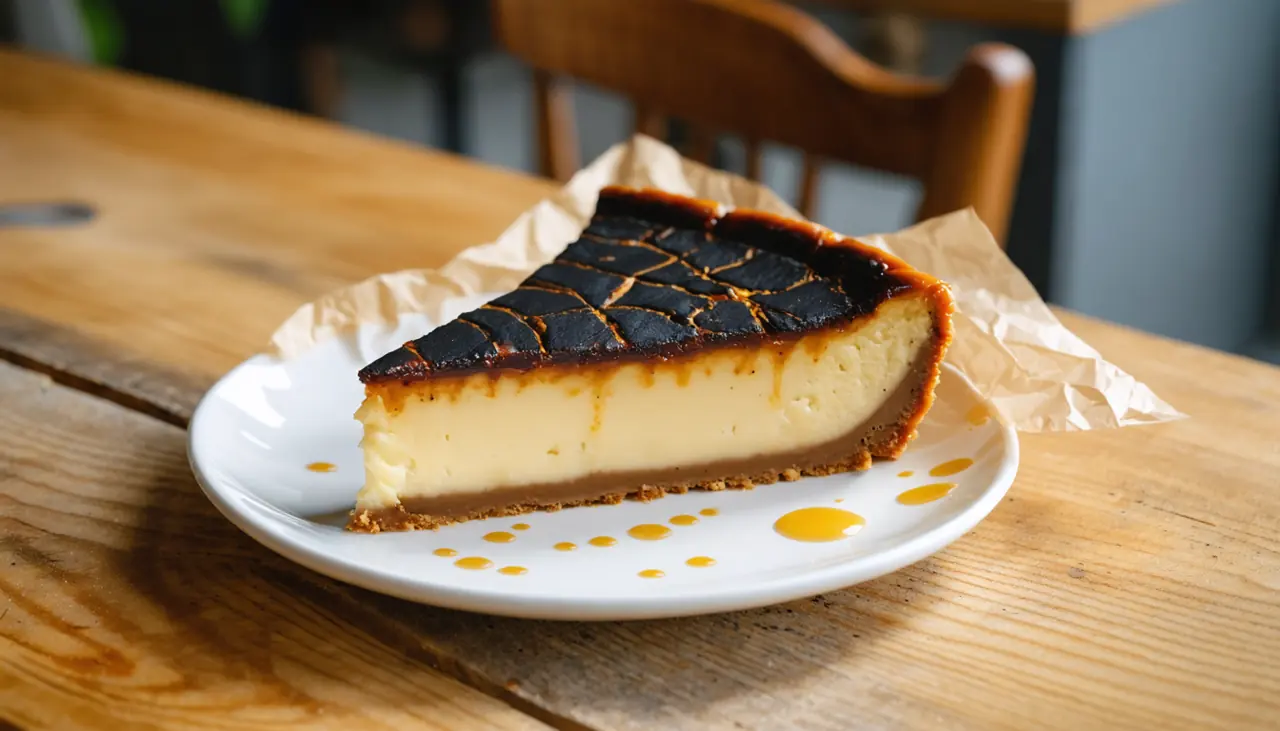
Gâteau au fromage basque brûlé
Un cheesecake sans base, cuit fort et vite jusqu'à ce que le dessus soit volontairement brûlé, avec un intérieur crémeux et tremblotant.
Portions
Ingrédients
Nutrition
Par portion
Étapes

Prepare the pan
Line a 22–24 cm (9-inch) springform pan with two overlapping sheets of parchment paper, pushing the paper right into the base and up the sides. Leave plenty of paper hanging over the rim, since the cake rises then sinks and you want a tall collar to hold it. Crumpling the paper and running it briefly under water first makes it soft and easy to mold without tearing.
✅ C'est prêt quand : the pan is lined all the way up the sides with at least 5 cm (2 inches) of paper standing above the rim

Beat cheese and sugar
In a large bowl, beat the cream cheese and sugar with electric beaters on medium speed for 2–3 minutes until completely smooth, scraping down the sides and bottom of the bowl halfway through so no lumps of cheese hide underneath. Having the cheese fully at room temperature is what gets it silky without over-beating.
- 1 kg cream cheese
- 350 g sugar
✅ C'est prêt quand : the mixture is smooth and glossy with no visible lumps

Add the eggs
Add the eggs one at a time, beating on low speed just until each one disappears into the mixture before adding the next. Beating gently and adding the eggs gradually keeps air out of the batter, which is exactly what gives this cheesecake its dense, custardy inside instead of a fluffy one.
- 7 large eggs
✅ C'est prêt quand : the batter is smooth and all the eggs are fully incorporated

Finish the batter
Pour in the cream, then sift the flour and salt directly over the bowl and whisk gently just until combined. Pass the whole batter through a sieve into a jug, pressing any stubborn lumps through with a spatula; this one step is the secret behind the silky, uncracked inside of a proper Basque cheesecake.
- 300 ml heavy cream
- 50 g flour
- 1/2 tsp salt
✅ C'est prêt quand : the batter pours like thick cream and is completely lump-free

Bake until burnt
Pour the batter into the lined pan and bake on a middle-low rack in an oven preheated to 230°C (450°F) for 35–45 minutes, with the fan function off if possible. The top should turn deeply dark brown, almost black in patches, as if scorched, while the centre still wobbles like soft jelly when you shake the pan gently; that wobble is what keeps the inside creamy once it cools.
✅ C'est prêt quand : the top is deeply burnished and almost black in places, and the centre still jiggles like set jelly

Cool and chill
Let the cheesecake cool in the pan at room temperature for about an hour, then cover and refrigerate for at least 4 hours, ideally overnight. The cold is what firms up that wobbly centre into clean, creamy slices; lift off the parchment collar and serve cold, or let it sit out a little for a softer bite.
✅ C'est prêt quand : the cheesecake is fully chilled and firm enough to slice cleanly but still creamy at the centre
Prepare the pan
Line a 22–24 cm (9-inch) springform pan with two overlapping sheets of parchment paper, pushing the paper right into the base and up the sides. Leave plenty of paper hanging over the rim, since the cake rises then sinks and you want a tall collar to hold it. Crumpling the paper and running it briefly under water first makes it soft and easy to mold without tearing.
✅ C'est prêt quand : the pan is lined all the way up the sides with at least 5 cm (2 inches) of paper standing above the rim
Beat cheese and sugar
In a large bowl, beat the cream cheese and sugar with electric beaters on medium speed for 2–3 minutes until completely smooth, scraping down the sides and bottom of the bowl halfway through so no lumps of cheese hide underneath. Having the cheese fully at room temperature is what gets it silky without over-beating.
- 1 kg cream cheese
- 350 g sugar
✅ C'est prêt quand : the mixture is smooth and glossy with no visible lumps
Add the eggs
Add the eggs one at a time, beating on low speed just until each one disappears into the mixture before adding the next. Beating gently and adding the eggs gradually keeps air out of the batter, which is exactly what gives this cheesecake its dense, custardy inside instead of a fluffy one.
- 7 large eggs
✅ C'est prêt quand : the batter is smooth and all the eggs are fully incorporated
Finish the batter
Pour in the cream, then sift the flour and salt directly over the bowl and whisk gently just until combined. Pass the whole batter through a sieve into a jug, pressing any stubborn lumps through with a spatula; this one step is the secret behind the silky, uncracked inside of a proper Basque cheesecake.
- 300 ml heavy cream
- 50 g flour
- 1/2 tsp salt
✅ C'est prêt quand : the batter pours like thick cream and is completely lump-free
Bake until burnt
Pour the batter into the lined pan and bake on a middle-low rack in an oven preheated to 230°C (450°F) for 35–45 minutes, with the fan function off if possible. The top should turn deeply dark brown, almost black in patches, as if scorched, while the centre still wobbles like soft jelly when you shake the pan gently; that wobble is what keeps the inside creamy once it cools.
✅ C'est prêt quand : the top is deeply burnished and almost black in places, and the centre still jiggles like set jelly
Cool and chill
Let the cheesecake cool in the pan at room temperature for about an hour, then cover and refrigerate for at least 4 hours, ideally overnight. The cold is what firms up that wobbly centre into clean, creamy slices; lift off the parchment collar and serve cold, or let it sit out a little for a softer bite.
✅ C'est prêt quand : the cheesecake is fully chilled and firm enough to slice cleanly but still creamy at the centre
The Story Behind the Dish
This cheesecake was created at La Viña, a small bar near San Sebastián's old town, where the owners baked their cheesecake hotter and faster than the traditional creamy, pale tarts of the region, letting the top blacken on purpose. There is no base or crust at all; the scorched top takes its place, adding a bittersweet contrast to the soft, barely set centre underneath.
For years it stayed a local secret, ordered by name in Basque bars and markets. Food writers and chefs who tasted it on trips to San Sebastián began recreating it at home, and in the 2010s it spread fast through restaurants and social media, becoming known worldwide simply as Basque burnt cheesecake.
⭐ Why It's Famous
It turns what looks like a baking mistake, a deliberately burnt top, into the whole point of the dessert, with a dense, custardy inside that stays creamy right up to the dark crust.
💡 Fun Fact
Many bakers around the world now make and share this cake without knowing it is named after the Basque Country, while the original recipe at La Viña in San Sebastián has barely changed since it was first baked.
San Sebastián, Basque Country
43.32°N, -1.98°W
Recettes similaires
Comments (0)
No comments yet. Be the first to share your thoughts!