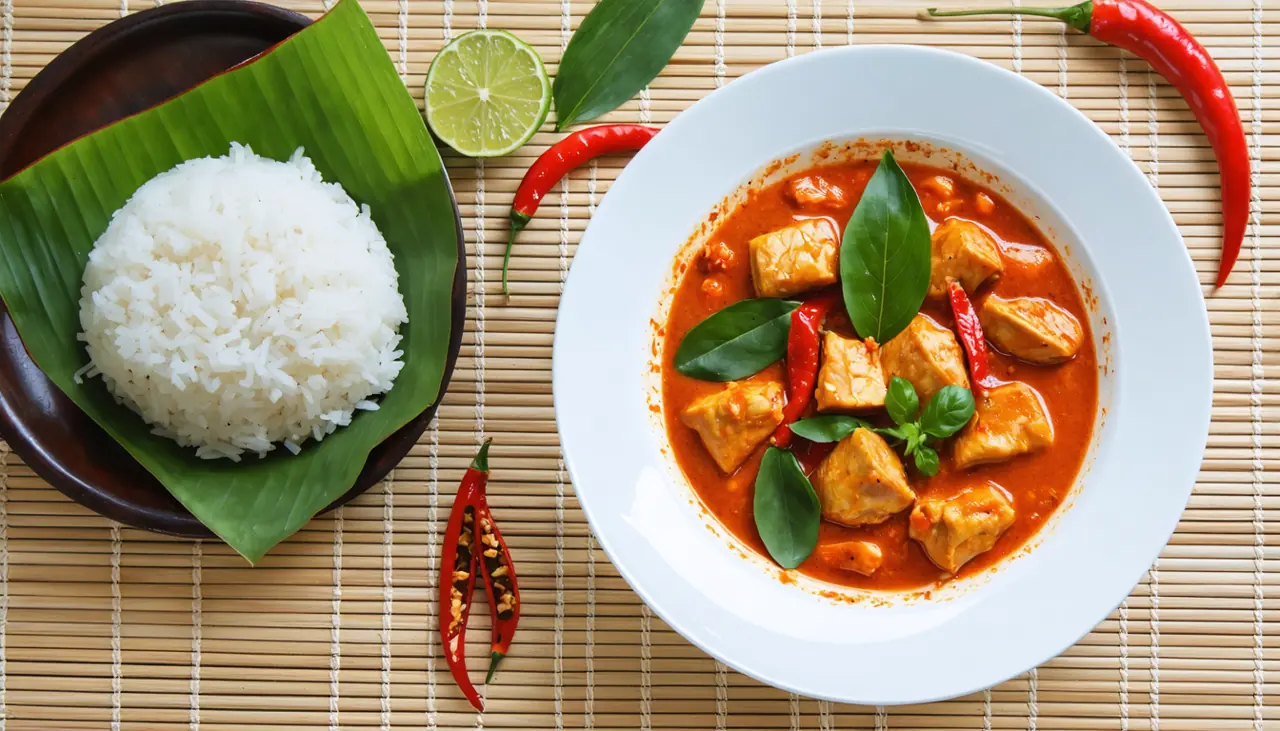
Curry Panang
Un curry épais et crémeux au poulet, à la noix de coco et aux cacahuètes moulues, parfumé au citron kaffir.
Portions
Ingrédients
Nutrition
Par portion
Étapes

Prep everything first
Slice the chicken thinly, slice the kaffir lime leaves, and chop or grate the palm sugar. Panang cooks fast once it starts, so have everything ready beside the stove.
- 500 g chicken, sliced
- 6 kaffir lime leaves, sliced
- 30 g palm sugar, chopped
✅ C'est prêt quand : all the ingredients are sliced, measured, and sitting ready

Crack the coconut cream
Scoop off about a third of the thick coconut cream (the part that rises to the top of the can) into a wok or heavy pot. Simmer over medium heat with no oil added, stirring occasionally, until it separates and a thin, fragrant layer of oil appears on the surface.
- about 130 ml coconut cream (the thick top layer)
✅ C'est prêt quand : the cream looks slightly broken, with a glossy oil sheen on top
Fry the curry paste
This step is part of Foodie Premium. Subscribe to unlock the full method, cooking mode and every recipe in the library.
Add the chicken
This step is part of Foodie Premium. Subscribe to unlock the full method, cooking mode and every recipe in the library.
Simmer until thick
This step is part of Foodie Premium. Subscribe to unlock the full method, cooking mode and every recipe in the library.
Balance the flavours
This step is part of Foodie Premium. Subscribe to unlock the full method, cooking mode and every recipe in the library.
Serve
This step is part of Foodie Premium. Subscribe to unlock the full method, cooking mode and every recipe in the library.
Prep everything first
Slice the chicken thinly, slice the kaffir lime leaves, and chop or grate the palm sugar. Panang cooks fast once it starts, so have everything ready beside the stove.
- 500 g chicken, sliced
- 6 kaffir lime leaves, sliced
- 30 g palm sugar, chopped
✅ C'est prêt quand : all the ingredients are sliced, measured, and sitting ready
Crack the coconut cream
Scoop off about a third of the thick coconut cream (the part that rises to the top of the can) into a wok or heavy pot. Simmer over medium heat with no oil added, stirring occasionally, until it separates and a thin, fragrant layer of oil appears on the surface.
- about 130 ml coconut cream (the thick top layer)
✅ C'est prêt quand : the cream looks slightly broken, with a glossy oil sheen on top
Fry the curry paste
This step is part of Foodie Premium. Subscribe to unlock the full method, cooking mode and every recipe in the library.
Add the chicken
This step is part of Foodie Premium. Subscribe to unlock the full method, cooking mode and every recipe in the library.
Simmer until thick
This step is part of Foodie Premium. Subscribe to unlock the full method, cooking mode and every recipe in the library.
Balance the flavours
This step is part of Foodie Premium. Subscribe to unlock the full method, cooking mode and every recipe in the library.
Serve
This step is part of Foodie Premium. Subscribe to unlock the full method, cooking mode and every recipe in the library.
The Story Behind the Dish
Panang curry belongs to the family of Thai curries built on a paste of dried chilies, lemongrass, galangal and kaffir lime, but it stands apart for its thickness and nuttiness: ground roasted peanuts are worked into the paste or the sauce, and far less liquid is used than in a typical red or green curry, so the dish stays thick enough to cling to the meat rather than pool around it.
Many food historians connect the name to Penang, the Malaysian island, pointing to the long culinary exchange between Thailand and Malaysia along their shared peninsula, even though the dish itself, as made and loved today, is thoroughly Thai.
⭐ Why It's Famous
It is prized for being richer, sweeter and milder than other Thai curries, with a nutty depth that makes it a favourite even among people who find other curries too fiery.
💡 Fun Fact
Despite its name, Panang curry as eaten today is rarely found in Penang itself; most food historians consider it a Thai invention that simply borrowed the place name.
Thailand
13.76°N, 100.50°E
Recettes similaires
Comments (0)
No comments yet. Be the first to share your thoughts!