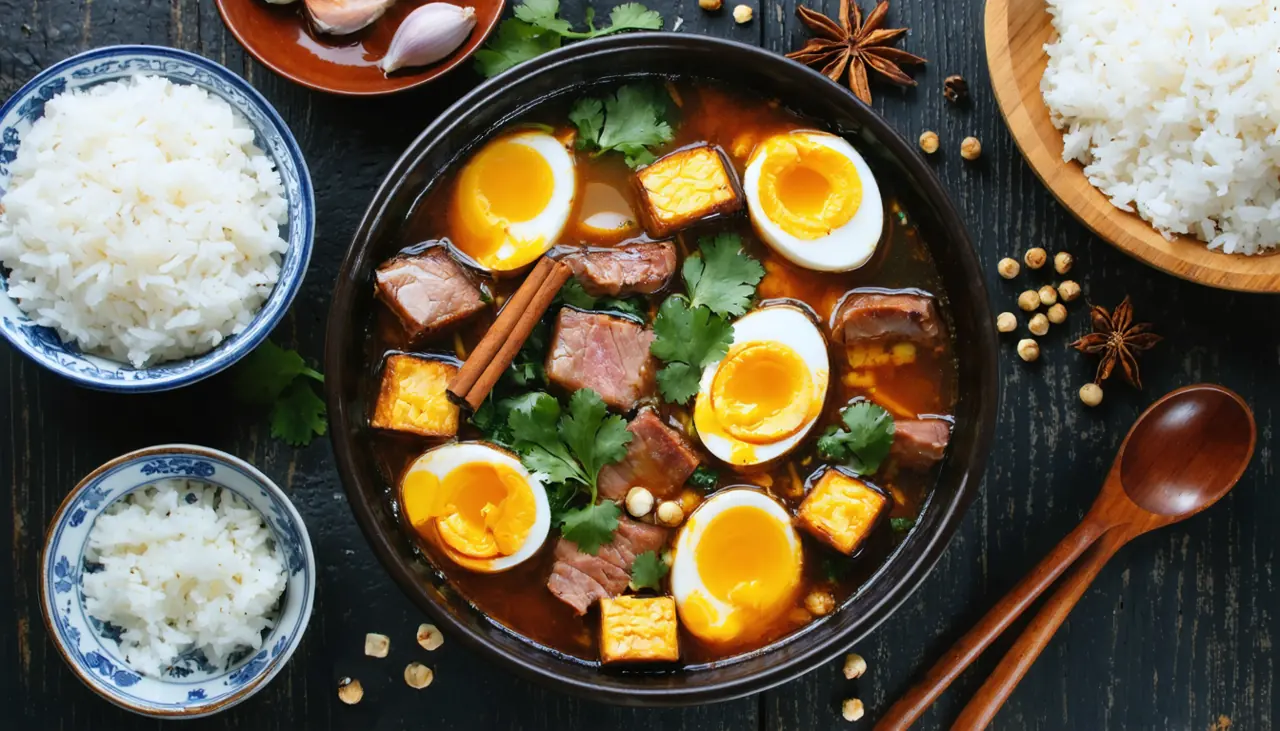
Œufs et porc braisés (Khai Palo)
Œufs durs et poitrine de porc fondante mijotés dans un bouillon de soja sucré aux cinq épices, avec du tofu doré.
Portions
Ingrédients
Nutrition
Par portion
Étapes

Hard-boil and peel the eggs
Lower the eggs gently into a pot of boiling water and cook for 10 minutes so the yolks are fully set. Drain and plunge straight into ice water for 5 minutes, then peel carefully under cool running water so the whites stay smooth and whole.
- 8 eggs
✅ C'est prêt quand : the eggs are cooked through, with firm whites and fully set yolks

Pound the aromatics
Crush the garlic, cilantro roots and white peppercorns together in a mortar, or blitz briefly in a small food processor, until you have a rough, wet paste. This pounded base is what gives khai palo its deep savoury backbone, so take the time to really crush it rather than just mincing the garlic.
- 6 cloves garlic
- 4 cilantro roots
- 1 tsp white peppercorns
✅ C'est prêt quand : the mixture looks like a sticky, fragrant paste, not whole pieces

Fry the tofu
Heat half the oil in a large heavy pot over medium-high heat. Fry the tofu cubes in batches until golden on at least two sides, then lift out onto a plate; this light crust keeps the tofu from falling apart during the long simmer later.
- 1 tbsp vegetable oil
- 400 g firm tofu
✅ C'est prêt quand : the tofu cubes have a light golden crust

Brown the pork and spices
Add the remaining oil to the same pot with the shallots and the pounded paste, and fry for a minute until fragrant. Add the pork belly, cinnamon sticks, star anise and five-spice powder, and brown the meat on all sides for about 5 minutes; this toasts the spices and builds the dark, warm aroma that defines the dish.
- 1 tbsp vegetable oil
- 2 shallots
- 700 g pork belly
- 2 cinnamon sticks
- 3 star anise
- 2 tsp five-spice powder
✅ C'est prêt quand : the pork is browned on the outside and the kitchen smells of warm spice

Simmer until tender
Pour in the water or stock, light soy sauce, dark soy sauce and palm sugar. Bring to a boil, skim off any foam, then cover and simmer on low heat for 1 to 1¼ hours, until the pork belly is completely tender and the broth tastes rounded and a little sweet.
- 1.5 litres water or stock
- 5 tbsp light soy sauce
- 3 tbsp dark soy sauce
- 60 g palm sugar
✅ C'est prêt quand : a piece of pork belly can be cut easily with a spoon and the broth has reduced slightly

Add eggs and tofu
Slide the peeled eggs and fried tofu into the pot. Simmer uncovered, without stirring too hard so the eggs stay whole, for 20–25 minutes, so they soak up the dark, sweet broth and the sauce reduces to a light, clingy consistency rather than staying watery.
- 8 eggs (from step 1)
- 400 g tofu (from step 3)
✅ C'est prêt quand : the egg whites are deep brown on the outside and the sauce coats the back of a spoon

Serve
Halve or quarter the eggs if you like, then ladle the pork, tofu and eggs into bowls over steamed rice, with plenty of the dark sauce. Scatter with fresh cilantro leaves and serve hot.
- to serve fresh cilantro leaves
Hard-boil and peel the eggs
Lower the eggs gently into a pot of boiling water and cook for 10 minutes so the yolks are fully set. Drain and plunge straight into ice water for 5 minutes, then peel carefully under cool running water so the whites stay smooth and whole.
- 8 eggs
✅ C'est prêt quand : the eggs are cooked through, with firm whites and fully set yolks
Pound the aromatics
Crush the garlic, cilantro roots and white peppercorns together in a mortar, or blitz briefly in a small food processor, until you have a rough, wet paste. This pounded base is what gives khai palo its deep savoury backbone, so take the time to really crush it rather than just mincing the garlic.
- 6 cloves garlic
- 4 cilantro roots
- 1 tsp white peppercorns
✅ C'est prêt quand : the mixture looks like a sticky, fragrant paste, not whole pieces
Fry the tofu
Heat half the oil in a large heavy pot over medium-high heat. Fry the tofu cubes in batches until golden on at least two sides, then lift out onto a plate; this light crust keeps the tofu from falling apart during the long simmer later.
- 1 tbsp vegetable oil
- 400 g firm tofu
✅ C'est prêt quand : the tofu cubes have a light golden crust
Brown the pork and spices
Add the remaining oil to the same pot with the shallots and the pounded paste, and fry for a minute until fragrant. Add the pork belly, cinnamon sticks, star anise and five-spice powder, and brown the meat on all sides for about 5 minutes; this toasts the spices and builds the dark, warm aroma that defines the dish.
- 1 tbsp vegetable oil
- 2 shallots
- 700 g pork belly
- 2 cinnamon sticks
- 3 star anise
- 2 tsp five-spice powder
✅ C'est prêt quand : the pork is browned on the outside and the kitchen smells of warm spice
Simmer until tender
Pour in the water or stock, light soy sauce, dark soy sauce and palm sugar. Bring to a boil, skim off any foam, then cover and simmer on low heat for 1 to 1¼ hours, until the pork belly is completely tender and the broth tastes rounded and a little sweet.
- 1.5 litres water or stock
- 5 tbsp light soy sauce
- 3 tbsp dark soy sauce
- 60 g palm sugar
✅ C'est prêt quand : a piece of pork belly can be cut easily with a spoon and the broth has reduced slightly
Add eggs and tofu
Slide the peeled eggs and fried tofu into the pot. Simmer uncovered, without stirring too hard so the eggs stay whole, for 20–25 minutes, so they soak up the dark, sweet broth and the sauce reduces to a light, clingy consistency rather than staying watery.
- 8 eggs (from step 1)
- 400 g tofu (from step 3)
✅ C'est prêt quand : the egg whites are deep brown on the outside and the sauce coats the back of a spoon
Serve
Halve or quarter the eggs if you like, then ladle the pork, tofu and eggs into bowls over steamed rice, with plenty of the dark sauce. Scatter with fresh cilantro leaves and serve hot.
- to serve fresh cilantro leaves
The Story Behind the Dish
Khai palo (ไข่พะโล้) traces back to the braising technique Teochew Chinese immigrants call 'lor', brought to Thailand by families who settled around Bangkok's river ports and markets. The name 'palo' is a Thai adaptation of the Chinese words for this five-spice soy braise, folded into Thai home cooking with local touches like palm sugar and pounded cilantro root.
Over generations it became an everyday family dish and a lunch-counter favourite, the kind of pot left to simmer quietly on the stove so the eggs and pork belly can slowly soak up the dark, fragrant broth.
⭐ Why It's Famous
Its deep mahogany broth, soft eggs and melting pork belly make it one of Thailand's most loved comfort foods, served everywhere from home kitchens to school cafeterias and street-side rice shops.
💡 Fun Fact
Vendors often keep a pot of khai palo simmering for hours, topping it up with more water, soy sauce and eggs through the day — the longer it cooks, the deeper the color and flavor become.
Central Thailand, from Thai-Chinese kitchens
13.76°N, 100.50°E
Recettes similaires
Comments (0)
No comments yet. Be the first to share your thoughts!