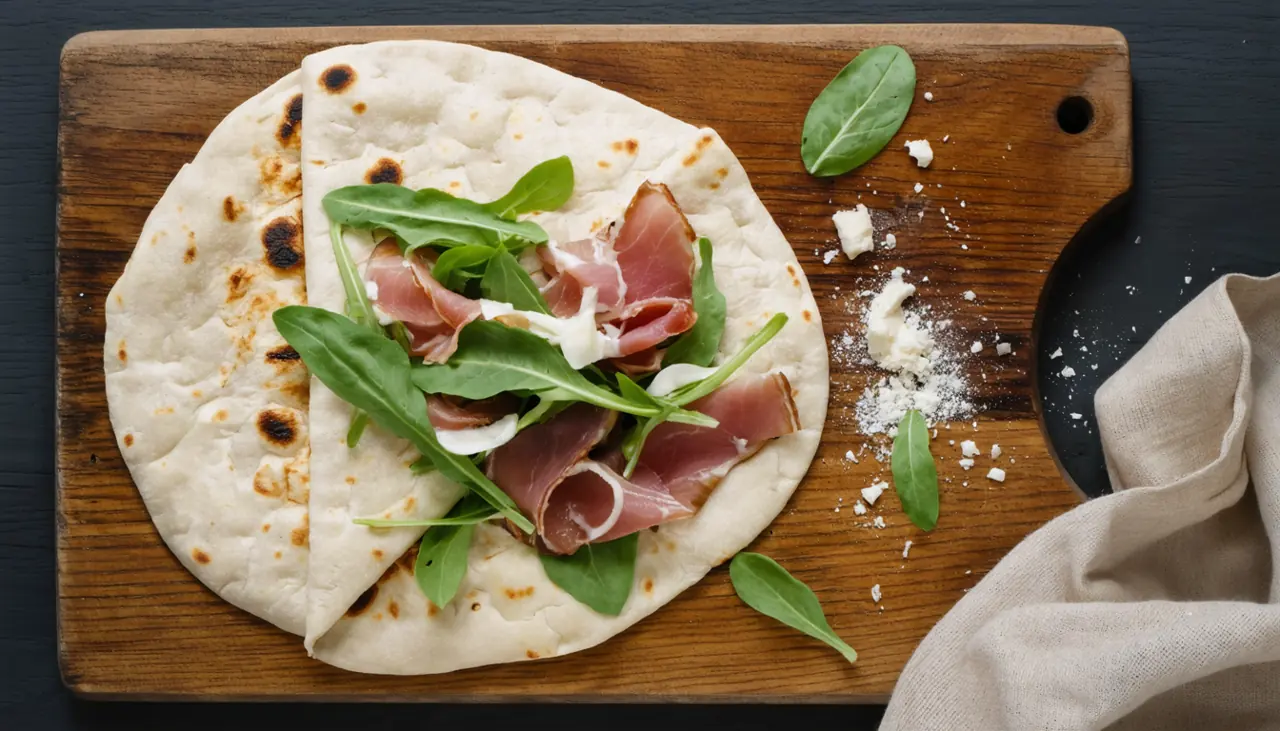
Romagna Flatbread (Piadina Romagnola)
A thin, griddle-cooked flatbread with a slightly chewy, blistered surface, folded warm around creamy squacquerone cheese, silky prosciutto and peppery arugula. Simple pantry ingredients, extraordinary result.
Servings
Ingredients
Nutrition
Per serving
Steps

Mix the dough
In a large bowl, whisk the flour, salt and baking soda together. Rub in the lard with your fingertips until no large lumps remain, then add the warm water gradually, mixing until a rough dough forms. Knead on a lightly floured surface for 8–10 minutes until smooth and elastic.
- 500 g flour
- 1 tsp salt
- 1/2 tsp baking soda
- 50 g lard
- 250 ml warm water
✅ Done when: the dough is smooth, slightly tacky but not sticky, and springs back when pressed

Rest the dough
Shape the dough into a ball, cover the bowl with a cloth or plastic wrap, and let it rest at room temperature. This relaxes the gluten so the piadine roll out thin without springing back.
✅ Done when: the dough feels relaxed and easy to stretch when poked

Divide and roll out
Divide the dough into 6 equal pieces and roll each into a ball. On a lightly floured surface, roll each ball into a very thin disc, about 20–22 cm across and 2–3 mm thick, dusting with extra flour as needed so it does not stick.
- extra flour for dusting
✅ Done when: each disc is thin, even and almost translucent at the edges

Cook on a dry griddle
Heat a non-stick pan or cast-iron griddle over medium-high heat with no oil. Cook each disc for about 1–2 minutes per side, pressing lightly with a spatula and flipping as soon as small golden-brown blisters appear; it should still be pliable, not crisp like a cracker.
✅ Done when: both sides show light golden-brown spots and the flatbread folds without cracking

Fill and fold
While each piadina is still warm, spread a generous layer of over half of it, top with slices of prosciutto crudo and a handful of arugula, then fold in half. Serve immediately, while warm and soft.
- 300 g
- 200 g prosciutto crudo
- 100 g arugula
Mix the dough
In a large bowl, whisk the flour, salt and baking soda together. Rub in the lard with your fingertips until no large lumps remain, then add the warm water gradually, mixing until a rough dough forms. Knead on a lightly floured surface for 8–10 minutes until smooth and elastic.
- 500 g flour
- 1 tsp salt
- 1/2 tsp baking soda
- 50 g lard
- 250 ml warm water
✅ Done when: the dough is smooth, slightly tacky but not sticky, and springs back when pressed
Rest the dough
Shape the dough into a ball, cover the bowl with a cloth or plastic wrap, and let it rest at room temperature. This relaxes the gluten so the piadine roll out thin without springing back.
✅ Done when: the dough feels relaxed and easy to stretch when poked
Divide and roll out
Divide the dough into 6 equal pieces and roll each into a ball. On a lightly floured surface, roll each ball into a very thin disc, about 20–22 cm across and 2–3 mm thick, dusting with extra flour as needed so it does not stick.
- extra flour for dusting
✅ Done when: each disc is thin, even and almost translucent at the edges
Cook on a dry griddle
Heat a non-stick pan or cast-iron griddle over medium-high heat with no oil. Cook each disc for about 1–2 minutes per side, pressing lightly with a spatula and flipping as soon as small golden-brown blisters appear; it should still be pliable, not crisp like a cracker.
✅ Done when: both sides show light golden-brown spots and the flatbread folds without cracking
Fill and fold
While each piadina is still warm, spread a generous layer of over half of it, top with slices of prosciutto crudo and a handful of arugula, then fold in half. Serve immediately, while warm and soft.
- 300 g
- 200 g prosciutto crudo
- 100 g arugula
The Story Behind the Dish
Piadina has roots in the simple flatbreads of rural Romagna, cooked for centuries on a flat terracotta or stone disc called a testo set over an open fire or embers. Farming families made it with just flour, water and a little fat, baking it to carry to the fields as a sturdy, portable bread.
In the 20th century, roadside kiosks called chioschi began selling piadine filled with local cured meats and cheeses, turning a humble peasant bread into one of Italy's most loved street foods, now protected with regional recognition.
⭐ Why It's Famous
It is prized for its thin, tender texture with a lightly blistered surface, and for how perfectly it wraps around Romagna's cured meats, cheeses and greens without competing with their flavor.
💡 Fun Fact
Piadina styles vary even within Romagna: the version from Rimini is thinner and softer, while piadine from inland hill towns are often thicker, closer to the original farmhouse bread.
Emilia-Romagna, especially the provinces of Forlì-Cesena, Rimini and Ravenna
44.07°N, 12.57°E
Related recipes
Comments (0)
No comments yet. Be the first to share your thoughts!