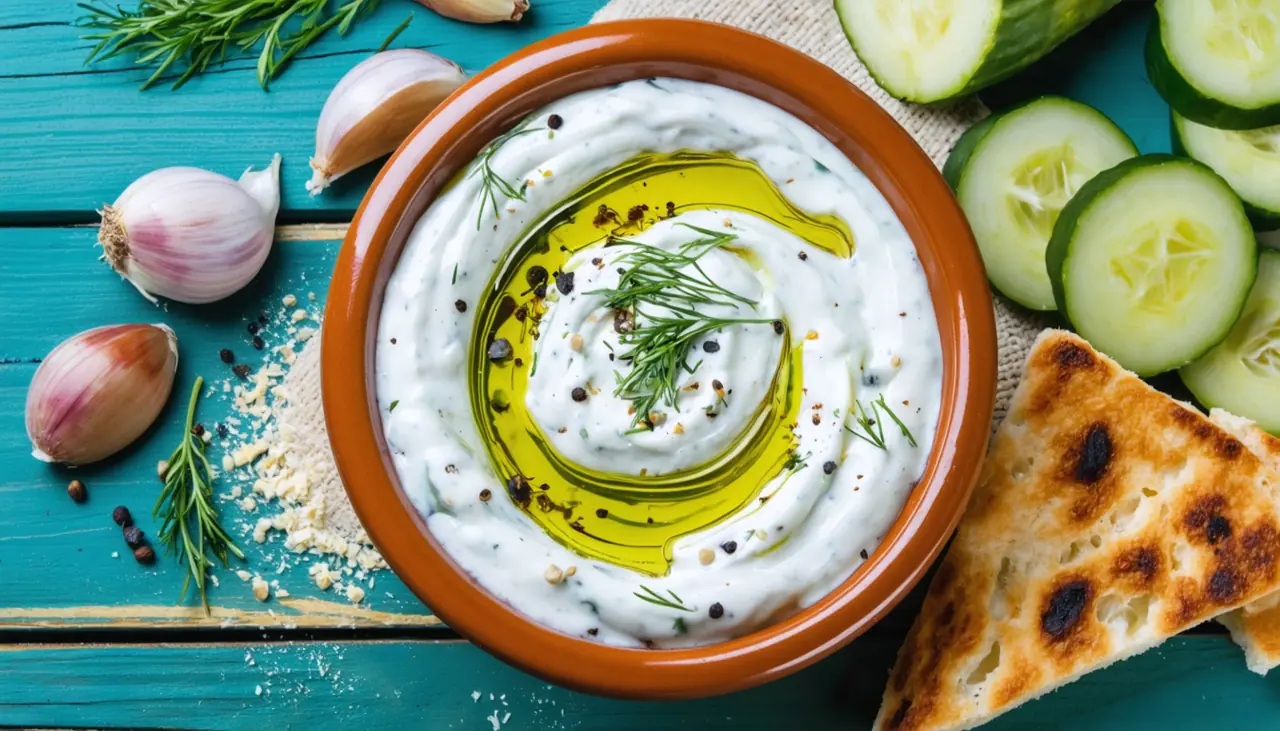
Tzatziki (Τζατζίκι)
A cooling Greek dip of thick strained yogurt blended with grated cucumber, garlic and dill, finished with good olive oil. Serve with warm pita, grilled meats, or spooned over roasted vegetables.
Servings
Ingredients
Nutrition
Per serving
Steps

Drain the cucumber
Peel the cucumber if the skin is thick, then grate it coarsely (no need to seed it). Toss with the coarse salt and tip into a sieve set over a bowl; let it drain for 20 minutes. Then squeeze handfuls firmly in a clean kitchen towel or paper towels to press out as much water as possible — this is the step that keeps your thick instead of watery.
- 1 large (about 400 g) cucumber
- 1 tsp coarse salt
✅ Done when: the cucumber feels dry and almost half its original volume after squeezing

Make a garlic paste
Finely mince the garlic, sprinkle the fine salt over it, then use the flat side of a knife to mash and smear it into a smooth paste on the cutting board. This tames the raw bite of the garlic and lets it spread evenly through the dip instead of hitting in sharp bits.
- 2–3 cloves garlic
- 1/4 tsp fine sea salt
✅ Done when: the garlic looks like a smooth, almost creamy paste with no visible chunks

Mix the base
In a bowl, stir together the yogurt, the well-drained cucumber, the garlic paste, 2 tablespoons of the olive oil, the vinegar (or lemon juice) and the dill. Stir just until evenly combined; overmixing can thin the yogurt and make the dip runny.
- 500 g Greek
- 2 tbsp olive oil (of the divided amount)
- 1 tbsp white wine vinegar or lemon juice
- 2 tbsp fresh dill
✅ Done when: the mixture is thick, speckled green with dill, and holds its shape on a spoon

Season and chill
Taste and add black pepper and, if needed, a little more salt. Cover and refrigerate for at least 30 minutes, ideally 1–2 hours; chilling lets the garlic and dill flavours settle into the yogurt and firms up the texture.
- to taste black pepper
✅ Done when: the dip is cold, firm enough to hold a spoon upright briefly, and the flavours taste blended rather than sharp

Serve
Spoon the into a shallow bowl, swirl the top with the back of the spoon, and drizzle over the remaining tablespoon of olive oil. Serve cold alongside warm pita, grilled meats or roasted vegetables.
- 1 tbsp olive oil (remaining, to drizzle)
Drain the cucumber
Peel the cucumber if the skin is thick, then grate it coarsely (no need to seed it). Toss with the coarse salt and tip into a sieve set over a bowl; let it drain for 20 minutes. Then squeeze handfuls firmly in a clean kitchen towel or paper towels to press out as much water as possible — this is the step that keeps your thick instead of watery.
- 1 large (about 400 g) cucumber
- 1 tsp coarse salt
✅ Done when: the cucumber feels dry and almost half its original volume after squeezing
Make a garlic paste
Finely mince the garlic, sprinkle the fine salt over it, then use the flat side of a knife to mash and smear it into a smooth paste on the cutting board. This tames the raw bite of the garlic and lets it spread evenly through the dip instead of hitting in sharp bits.
- 2–3 cloves garlic
- 1/4 tsp fine sea salt
✅ Done when: the garlic looks like a smooth, almost creamy paste with no visible chunks
Mix the base
In a bowl, stir together the yogurt, the well-drained cucumber, the garlic paste, 2 tablespoons of the olive oil, the vinegar (or lemon juice) and the dill. Stir just until evenly combined; overmixing can thin the yogurt and make the dip runny.
- 500 g Greek
- 2 tbsp olive oil (of the divided amount)
- 1 tbsp white wine vinegar or lemon juice
- 2 tbsp fresh dill
✅ Done when: the mixture is thick, speckled green with dill, and holds its shape on a spoon
Season and chill
Taste and add black pepper and, if needed, a little more salt. Cover and refrigerate for at least 30 minutes, ideally 1–2 hours; chilling lets the garlic and dill flavours settle into the yogurt and firms up the texture.
- to taste black pepper
✅ Done when: the dip is cold, firm enough to hold a spoon upright briefly, and the flavours taste blended rather than sharp
Serve
Spoon the into a shallow bowl, swirl the top with the back of the spoon, and drizzle over the remaining tablespoon of olive oil. Serve cold alongside warm pita, grilled meats or roasted vegetables.
- 1 tbsp olive oil (remaining, to drizzle)
The Story Behind the Dish
Yogurt-and-cucumber mixtures are common across the eastern Mediterranean and Middle East, and tzatziki as Greeks make it today took shape during the long centuries of contact under Ottoman rule, when dishes like Turkish cacık spread and were adapted in Greek kitchens. Over time it became distinctly Greek through the use of thick strained yogurt, plenty of garlic, and good local olive oil.
Today it is a fixture on every taverna table, served as a meze with bread, spooned next to souvlaki and gyro, or stirred into salads, and nearly every family has its own small adjustments to the ratio of cucumber, garlic and herbs.
⭐ Why It's Famous
It is cool, garlicky and endlessly useful, equally at home as a dip, a sauce for grilled meat, or a cooling counterpoint to a hot summer meal.
💡 Fun Fact
There is friendly disagreement across Greece over whether dill or mint belongs in tzatziki; both are traditional depending on the region and the family.
Greece, nationwide
37.98°N, 23.73°E
Related recipes
Comments (0)
No comments yet. Be the first to share your thoughts!