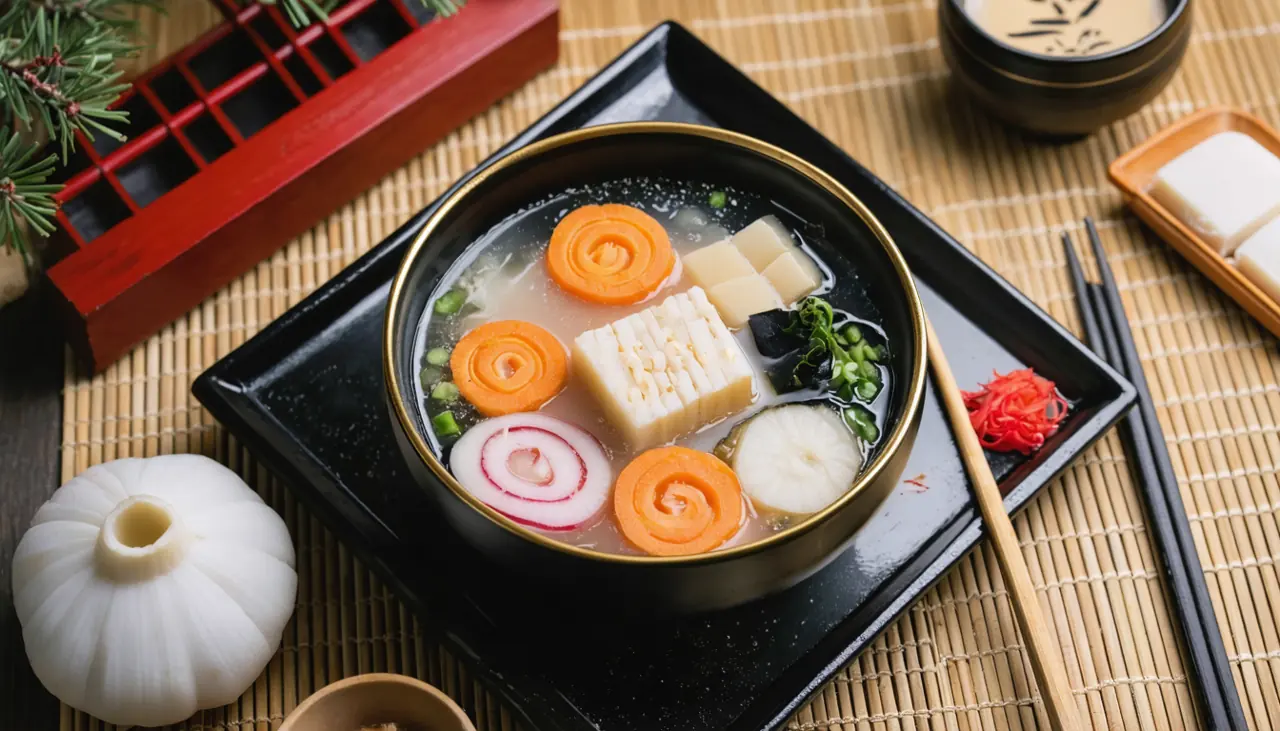
New Year Mochi Soup (Ozoni)
A clear, delicate dashi soup with chicken, root vegetables and a chewy square of grilled mochi, eaten on the first morning of the new year all over Japan. Humble, warming, and full of good-luck symbolism in every bowl.
Servings
Ingredients
Nutrition
Per serving
Steps

Make the dashi
Put the kombu in the cold water and let it soak for about 20 minutes, then set the pot over medium-low heat. Just as tiny bubbles begin to form at the edges (do not let it reach a full boil, or the kombu turns bitter), lift out the kombu. Add the bonito flakes, turn off the heat, and let them steep for 5 minutes before straining the liquid through a fine sieve.
- 10 g kombu
- 1.1 litres water
- 15 g bonito flakes
✅ Done when: the dashi is pale gold, clear and smells lightly of the sea and smoke

Simmer chicken and vegetables
Return the strained to the pot and add the chicken, carrot, daikon and taro. Simmer gently over medium-low heat, skimming off any grey foam that rises, until the chicken is cooked through and the vegetables are tender when pierced with a knife.
- 150 g chicken thigh
- 1 small carrot
- 150 g daikon
- 4 small taro root
✅ Done when: the chicken shows no pink inside and the vegetables are soft but still hold their shape

Season the soup
Stir in the soy sauce, mirin and salt. Keep the soup at a gentle simmer, never a hard boil, for a few more minutes so the flavours settle. Taste and adjust with a touch more soy sauce if you like it stronger; the broth should stay light and clear, not salty-heavy.
- 2 tbsp soy sauce
- 1 tbsp mirin
- 1/2 tsp salt
✅ Done when: the broth tastes clean and savoury, pale amber in colour

Grill the mochi
While the soup simmers, place the pieces on a rack under a hot broiler or in a toaster oven. Grill, turning once, until they puff up, blister in spots and turn lightly golden; watch closely, as can burn fast once it starts to brown. If a piece bursts open, that is normal and a good sign it is ready.
- 4 pieces kiri
✅ Done when: the mochi is puffed, soft all the way through, and lightly charred in a few spots

Assemble and serve
Place a piece of grilled in each bowl and ladle the hot soup with chicken and vegetables over it. Top with a slice of kamaboko, a few strands of mitsuba or spinach, and a thin strip of yuzu zest. Serve immediately, while the is still soft and the broth is steaming hot.
- 4 slices kamaboko
- 40 g mitsuba or spinach
- a few strips yuzu or lemon zest
Make the dashi
Put the kombu in the cold water and let it soak for about 20 minutes, then set the pot over medium-low heat. Just as tiny bubbles begin to form at the edges (do not let it reach a full boil, or the kombu turns bitter), lift out the kombu. Add the bonito flakes, turn off the heat, and let them steep for 5 minutes before straining the liquid through a fine sieve.
- 10 g kombu
- 1.1 litres water
- 15 g bonito flakes
✅ Done when: the dashi is pale gold, clear and smells lightly of the sea and smoke
Simmer chicken and vegetables
Return the strained to the pot and add the chicken, carrot, daikon and taro. Simmer gently over medium-low heat, skimming off any grey foam that rises, until the chicken is cooked through and the vegetables are tender when pierced with a knife.
- 150 g chicken thigh
- 1 small carrot
- 150 g daikon
- 4 small taro root
✅ Done when: the chicken shows no pink inside and the vegetables are soft but still hold their shape
Season the soup
Stir in the soy sauce, mirin and salt. Keep the soup at a gentle simmer, never a hard boil, for a few more minutes so the flavours settle. Taste and adjust with a touch more soy sauce if you like it stronger; the broth should stay light and clear, not salty-heavy.
- 2 tbsp soy sauce
- 1 tbsp mirin
- 1/2 tsp salt
✅ Done when: the broth tastes clean and savoury, pale amber in colour
Grill the mochi
While the soup simmers, place the pieces on a rack under a hot broiler or in a toaster oven. Grill, turning once, until they puff up, blister in spots and turn lightly golden; watch closely, as can burn fast once it starts to brown. If a piece bursts open, that is normal and a good sign it is ready.
- 4 pieces kiri
✅ Done when: the mochi is puffed, soft all the way through, and lightly charred in a few spots
Assemble and serve
Place a piece of grilled in each bowl and ladle the hot soup with chicken and vegetables over it. Top with a slice of kamaboko, a few strands of mitsuba or spinach, and a thin strip of yuzu zest. Serve immediately, while the is still soft and the broth is steaming hot.
- 4 slices kamaboko
- 40 g mitsuba or spinach
- a few strips yuzu or lemon zest
The Story Behind the Dish
Ozoni takes its name from zoni, meaning roughly 'boiled together,' and grew out of samurai-era meals where mochi, vegetables and whatever stock was on hand were simmered in one pot before battle or celebration. Over time it became fixed as the dish eaten on the morning of January 1st, meant to be the first food of the new year.
Every region, and often every family, makes it differently: Tokyo and much of eastern Japan favour a clear soy-seasoned dashi with square, grilled mochi like this one, while Kyoto and the Kansai region simmer round, boiled mochi in a sweet white miso broth. The vegetables, too, shift with what each region grows.
⭐ Why It's Famous
It is the ceremonial first meal of the Japanese new year, served alongside osechi dishes, and the chewy mochi is eaten as a wish for strength, stretch and long life in the year ahead.
💡 Fun Fact
Because mochi is so sticky and dense, Japanese fire and emergency services issue warnings every New Year reminding people, especially the elderly, to cut it small and chew carefully.
Japan, nationwide, with strong regional variations
35.68°N, 139.65°E
Related recipes
Comments (0)
No comments yet. Be the first to share your thoughts!