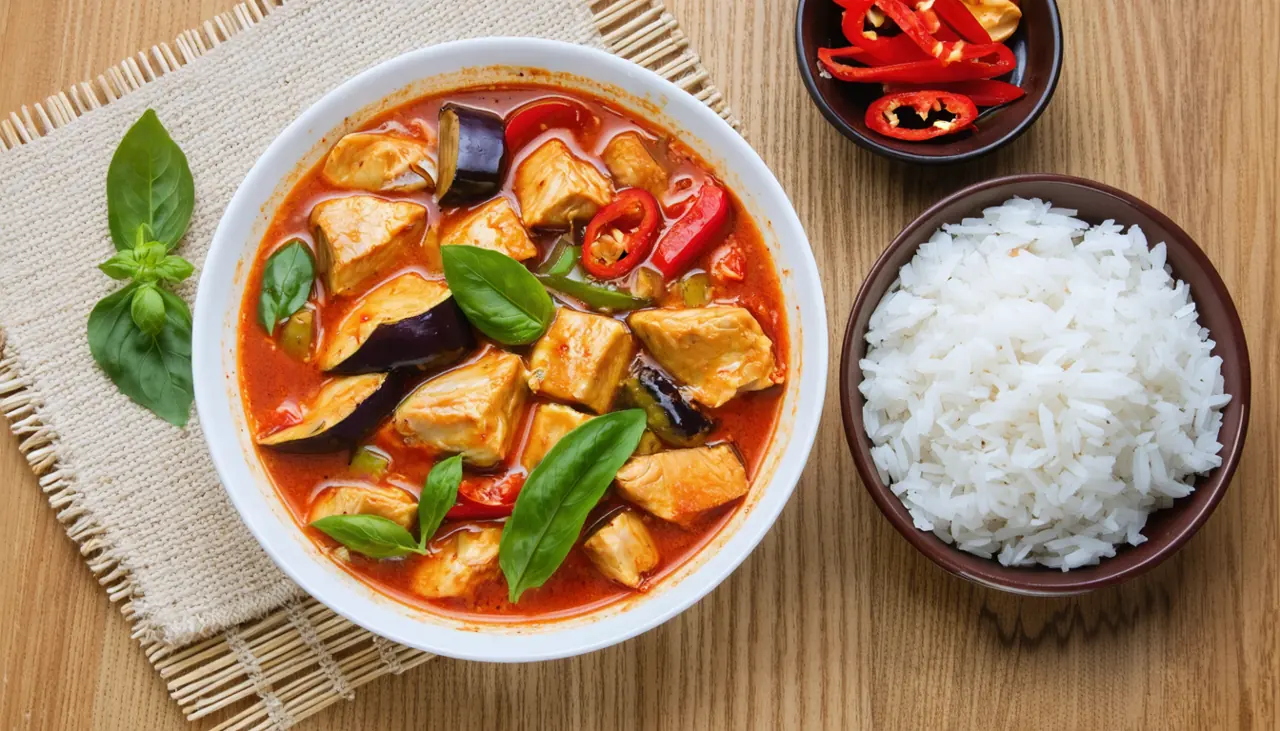
Red Curry (Gaeng Daeng)
A rich, red-gold coconut curry built by frying red chili paste in thick coconut cream until it splits and turns fragrant, then simmered with tender chicken, eggplant and sweet basil. Deeply savoury, a little sweet, and warmly spicy.
Servings
Ingredients
Nutrition
Per serving
Steps

Prep everything first
Cut the chicken into bite-size pieces, quarter the eggplant, slice the pepper and chilies, tear the kaffir lime leaves, and pick the basil leaves. Having everything ready matters because the curry moves fast once the paste starts frying.
- 500 g chicken thighs
- 100 g Thai eggplants
- 1 red bell pepper
- 7 kaffir lime leaves
- 25 g Thai basil leaves
- 2 red chilies
✅ Done when: all ingredients are cut and sitting in separate bowls, ready to go

Crack the coconut cream
Without shaking the cans, scoop just the thick cream from the top into a wok or heavy pot. Heat over medium until it bubbles and you see the oil separate and pool at the edges — this is called "cracking" the coconut cream and it's the base of a proper Thai curry.
- about 200 ml (the thick top layer) coconut milk
✅ Done when: the cream looks oily and slightly translucent at the edges, no longer a flat white liquid

Fry the curry paste
Add the curry paste to the cracked cream and fry, stirring often, until it darkens, smells deeply fragrant and the oil visibly separates around it again. This step builds the whole flavour of the curry, so don't rush it or the curry will taste raw and flat.
- 70 g Thai red curry paste
✅ Done when: the paste is a deep brick-red, smells toasted and fragrant, with oil glistening on the surface

Brown the chicken
Add the chicken pieces and stir to coat them well in the fried paste. Cook for 3–4 minutes, turning often, until the outside of the chicken is no longer pink.
- 500 g chicken thighs (from step 1)
✅ Done when: the chicken is coated red and opaque on the outside

Simmer the curry
Pour in the rest of the coconut milk along with the fish sauce and palm sugar. Bring to a gentle simmer, uncovered, and cook until the chicken is fully cooked through — the surface of the curry should stay just barely bubbling, not boiling hard, or the coconut milk can split and look grainy.
- 600 ml (remaining) coconut milk
- 2 tbsp fish sauce
- 1½ tbsp palm sugar
✅ Done when: the chicken is cooked through (no pink inside) and the curry is lightly thickened

Add the vegetables
Stir in the eggplant, bell pepper and torn kaffir lime leaves. Simmer gently until the eggplant is tender but still holds its shape.
- 100 g Thai eggplants
- 1 red bell pepper
- 6 torn kaffir lime leaves
✅ Done when: the eggplant is tender when pierced and the pepper has softened slightly but keeps some bite

Finish and serve
Turn off the heat and stir in the basil leaves — the residual heat will wilt them without turning them dull or bitter. Taste and adjust with a little more fish sauce or palm sugar if needed, then serve hot over jasmine rice, scattered with sliced chilies and the extra kaffir lime leaf.
- 25 g Thai basil leaves
- 2 sliced red chilies
- 1 sliced kaffir lime leaf (garnish)
- to serve jasmine rice
✅ Done when: the basil has just wilted into the sauce and smells fragrant, not boiled
Prep everything first
Cut the chicken into bite-size pieces, quarter the eggplant, slice the pepper and chilies, tear the kaffir lime leaves, and pick the basil leaves. Having everything ready matters because the curry moves fast once the paste starts frying.
- 500 g chicken thighs
- 100 g Thai eggplants
- 1 red bell pepper
- 7 kaffir lime leaves
- 25 g Thai basil leaves
- 2 red chilies
✅ Done when: all ingredients are cut and sitting in separate bowls, ready to go
Crack the coconut cream
Without shaking the cans, scoop just the thick cream from the top into a wok or heavy pot. Heat over medium until it bubbles and you see the oil separate and pool at the edges — this is called "cracking" the coconut cream and it's the base of a proper Thai curry.
- about 200 ml (the thick top layer) coconut milk
✅ Done when: the cream looks oily and slightly translucent at the edges, no longer a flat white liquid
Fry the curry paste
Add the curry paste to the cracked cream and fry, stirring often, until it darkens, smells deeply fragrant and the oil visibly separates around it again. This step builds the whole flavour of the curry, so don't rush it or the curry will taste raw and flat.
- 70 g Thai red curry paste
✅ Done when: the paste is a deep brick-red, smells toasted and fragrant, with oil glistening on the surface
Brown the chicken
Add the chicken pieces and stir to coat them well in the fried paste. Cook for 3–4 minutes, turning often, until the outside of the chicken is no longer pink.
- 500 g chicken thighs (from step 1)
✅ Done when: the chicken is coated red and opaque on the outside
Simmer the curry
Pour in the rest of the coconut milk along with the fish sauce and palm sugar. Bring to a gentle simmer, uncovered, and cook until the chicken is fully cooked through — the surface of the curry should stay just barely bubbling, not boiling hard, or the coconut milk can split and look grainy.
- 600 ml (remaining) coconut milk
- 2 tbsp fish sauce
- 1½ tbsp palm sugar
✅ Done when: the chicken is cooked through (no pink inside) and the curry is lightly thickened
Add the vegetables
Stir in the eggplant, bell pepper and torn kaffir lime leaves. Simmer gently until the eggplant is tender but still holds its shape.
- 100 g Thai eggplants
- 1 red bell pepper
- 6 torn kaffir lime leaves
✅ Done when: the eggplant is tender when pierced and the pepper has softened slightly but keeps some bite
Finish and serve
Turn off the heat and stir in the basil leaves — the residual heat will wilt them without turning them dull or bitter. Taste and adjust with a little more fish sauce or palm sugar if needed, then serve hot over jasmine rice, scattered with sliced chilies and the extra kaffir lime leaf.
- 25 g Thai basil leaves
- 2 sliced red chilies
- 1 sliced kaffir lime leaf (garnish)
- to serve jasmine rice
✅ Done when: the basil has just wilted into the sauce and smells fragrant, not boiled
The Story Behind the Dish
Gaeng daeng belongs to the family of Thai curries built on a pounded paste of dried red chilies, garlic, shallots, lemongrass and galangal, cooked down with coconut cream. Its name simply means "red curry," the colour coming from dried chilies rather than the fresh green ones used in gaeng khiao wan.
It is traditionally made with beef or duck as well as chicken, and home cooks have long varied the vegetables added — eggplant, bamboo shoots or green beans — depending on what's in season.
⭐ Why It's Famous
It strikes a balance that Thai curries are loved for: rich and a little sweet from the coconut cream and palm sugar, deeply savoury from fish sauce, and warmly spiced rather than sharply hot, finished with the unmistakable scent of Thai basil and kaffir lime.
💡 Fun Fact
The red colour comes entirely from dried chilies pounded into the paste — using fresh red chilies instead gives a lighter, pinkish curry, not the deep brick-red of real gaeng daeng.
Central Thailand
13.76°N, 100.50°E
Related recipes
Comments (0)
No comments yet. Be the first to share your thoughts!